From the Desk of Chris Trahan Cain, Executive Director | | | Understanding Chronic Health Conditions in Construction Workers | | |
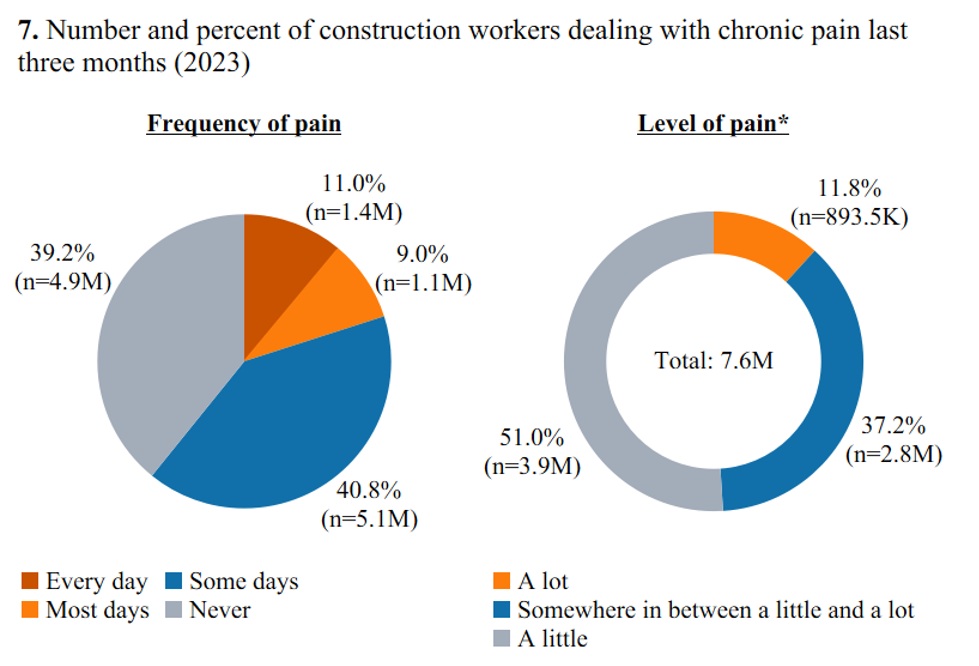
The August issue of CPWR’s Data Bulletin highlights a key issue in the safety and health of construction workers: chronic health conditions. The exposures and hazards they face can lead to chronic conditions such as high blood pressure, heart conditions, strokes, cancer, pain, and anxiety/depression.
This Data Bulletin’s examination of chronic health conditions is one part of CPWR’s ongoing effort to understand disease patterns among construction workers. In addition to the six-time-a-year Data Bulletin, we produce the Construction Chart Book, which offers data not only on chronic conditions but also on medical expenditures and occupational exposures. Our Building Trades National Medical Screening Program (BTMed), which provides free medical exams to construction workers who worked at U.S. Department of Energy nuclear weapons sites, uses data on its 26,000 participants to show long-term health effects of construction jobs.
CPWR continues to explore the hazards contributing to these conditions -- especially how to mitigate them. Current projects include studies of how to reduce painters’ chemical exposures and how exoskeletons could reduce musculoskeletal disorders (MSDs) and the accompanying pain.
Our monitoring and research form the foundation for our efforts to create changes that improve the health of construction workers. For example, our Research to Practice (r2p) team offers physicians' alerts that educate workers and their doctors on common exposures and related health conditions. We offer free training programs designed to reduce hearing loss and MSDs, as well as other resources to prevent injuries -- and chronic conditions -- from falls, head trauma, and silica inhalation. And we continue to expand our work to protect workers’ mental health.
| | TOOLS FOR SAFETY AND HEALTH | |
New Guide for Preventing Workplace Harassment and Violence
CPWR has just released a guide to help construction employers and workforce leaders develop and implement a program to that can prevent harassment and physical violence on jobsites. Acts of violence are the third leading cause of fatal occupational injuries in the U.S., and physical violence often follows harassment, intimidation, bullying, or other threatening behavior. In addition, suicide and opioid overdoses combined are killing more than 16,000 construction workers each year, with workplace harassment and bullying as one known contributing factor. Like other occupational safety hazards, workplace harassment and violence are recognizable, foreseeable, and preventable, and risks can be identified and mitigated with appropriate policies, procedures, and precautions. Developed through a review of relevant guidance and literature along with input from industry experts, “Preventing Workplace Harassment & Physical Violence in Construction” offers guidance on assessing risks, planning to prevent violence, and building a culture of care and respect, as well as a sample plan.
Data Dashboards, Hazard Alert Cards Updated
CPWR continues to update our free resources, so they remain valuable for people across the industry. This month seven interactive Data Dashboards have new data: Business Owner Demographics; Electrical Injuries; Falls, Slips and Trips; Hispanic Employment; OSHA Chemical Exposures; OSHA Citations and Inspections, and Women in Construction. Also, two Hazard Alert Cards -- short, image-driven materials that deliver simple, direct messages for protection against safety and health hazards -- have been revised. Updated cards for Carbon Monoxide and Silica are available in English and Spanish online, as are cards about more than 30 other topics.
| |
Evaluation of Early Lung Cancer Detection in a Population at High Risk due to Occupation. Knut Ringen, John Dement, Sammy Almashat, Marianne Cloeren, William Grier, Stella Hines, Laura Welch, Kim Cranford, Janet Shorter, Patricia Quinn, Anna Chen. American Journal of Industrial Medicine. 2025. Read the abstract and the Key Finding.
Apply Now for a Small Study Grant
Since 1993, our Small Study Program has provided nearly 150 research teams with up to $30,000 to initiate short-term studies that:
- Investigate potential risks from emerging hazards and industry changes.
- Explore new approaches for addressing persistent hazards.
- Create and test promising interventions to improve worker health and safety.
- Accelerate research on emerging and persistent safety and health issues.
The program is particularly interested in projects that reach high-risk small employers and develop interventions that can be immediately applied on the job. Support for the Small Studies program comes through CPWR’s cooperative agreement with the National Institute for Occupational Safety and Health (NIOSH) and private sector funding from the McElhattan Foundation. Applications are reviewed on a rolling basis. Learn about the application process and past and current studies on the Small Studies main webpage.
| | |
Wednesday, August 19 at 2:00 p.m. ET
Preventing Exposure to Electrical Hazards in Construction
Electrical hazards remain one of the most serious risks on construction sites and in industrial work environments – even for people who don’t work directly with electricity. CPWR invites you to join our webinar to learn more about the McElhattan Foundation’s Zero Electrocution Challenge and hear from industry experts at Zurich Insurance as they discuss the fundamentals of electrical safety, including common hazards and exposures and effective prevention and control methods. The session will also highlight the critical role of pre-task planning in safety, featuring lessons learned from research and practical resources. An interactive Q&A session will follow the presentations to allow attendees to engage with our panel. Whether you're a contractor, safety professional, supervisor, or worker looking to strengthen your electrical safety knowledge, this session offers actionable guidance to create safer workplaces and prevent serious incidents.
Panelists:
-
Chris Trahan Cain, CIH, Executive Director, CPWR
-
Jocelyn Horner Kelly, Ph.D., Executive Director, McElhattan Foundation
-
Joseph McManigal, CSP, CRIS, CESCP, CIT, Senior Risk Engineering Consultant, Zurich Resilience Solutions
-
Babak Memarian, PhD, CSP, CHST, Senior Risk Engineering Consultant, Zurich Resilience Solutions
Click here to register and submit questions in advance.
Live Spanish interpretation will be available.
| | |
Take Part in Safe & Sound Week
Registration is now open for Safe & Sound Week, the nationwide event held each August to recognize the successes of workplace safety and health programs and offer information and ideas on how to keep America’s workers safe. CPWR is proud to again be one of the organizers of the event, which this year takes place August 10 through 16. Learn more about how to participate, including resources that support putting on an event, on the OSHA website.
Deadline Extended for $2 Million Safety Challenge
Our partners at McElhattan Foundation have extended the registration deadline for the Zero Electrocution Challenge, which invites ground-breaking proposals to end fatal workplace electrocutions.
The Zero Electrocution Challenge is the inaugural challenge of ZERO 2050, a recurring national competition to end workplace fatalities. Managed by McElhattan Foundation, the Zero Electrocution Challenge is seeking breakthrough solutions that eliminate life-threatening tasks that lead to fatal electrocution on the job. Strong proposals for the challenge should be effective, game-changing, feasible, and scalable. Two winners will each receive up to $1 million.
To learn more and register, visit the Zero Electrocution Challenge website and review the readiness tool to determine eligibility. To participate, register no later than September 1 at 5:00 p.m. ET. Email [email protected] with any questions.
| | | | |