|
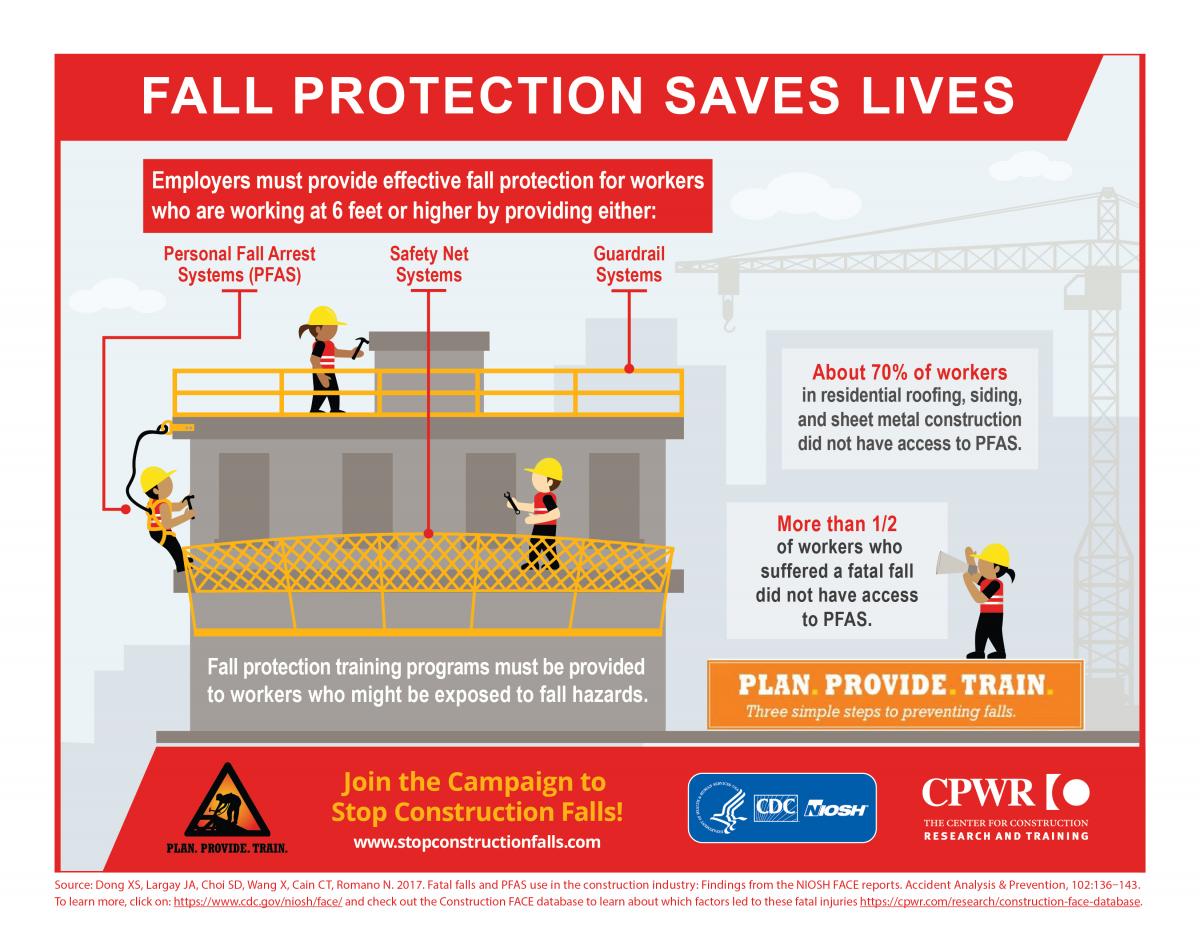
Today marks the start of the 13th annual National Safety Stand-Down to Prevent Falls in Construction. Part of the year-round National Campaign to Prevent Falls in Construction, the Stand-Down features live and virtual events across the country, including three CPWR webinars this week you can sign up for below.
CPWR is proud to be one of the campaign’s founders and, more broadly, a leader in the efforts to eliminate this hazard. In recent years, falls have annually caused more than 300 deaths and 20,000 injuries. Our response demonstrates our overall approach to improving the safety and health of the country’s construction workers: monitoring data, investigating solutions, developing tools, and evaluating impact.
Monitoring Trends
Information is crucial to understanding and eliminating hazards. From CPWR’s early years, our Data Center has used major national datasets, such as the Census of Fatal Occupational Injuries and the Survey of Occupational Injuries and Illnesses, to identify the magnitude of fall-related injuries among construction workers and guide interventions.
We provide the industry regular updates on this hazard, breaking falls out by categories such as subsector and type (fall, slip, or trip, fall to a lower level). One of the main ways we share this information is the Construction Chart Book (now in its 7th edition), which provides an unparalleled picture of the U.S. construction industry; another is the six-times-a-year Data Bulletin, with each issue focusing on a specific topic. The Falls Data Dashboard has introduced dynamic key findings and charts that update with selected filters, enabling users to investigate trends in both fatal and nonfatal falls.
Data is just one of the ways CPWR builds evidence. We have conducted studies like the Fall Experience Survey, which interviewed workers to identify underlying factors in the falls they had witnessed, including inadequate planning, gaps in fall protection use, and jobsite safety culture.
Exploring Solutions
CPWR has supported a range of research on methods for reducing falls. Our Small Study program, which offers up to $30,000 to investigate promising approaches, has supported projects that examined how to make rooftop solar installation safer and whether jobsite drones affect workers at height.
One of our recent multi-year research projects focused on residential construction, where two-thirds of fatalities result from falls. This work led to the development of the Foundations for Safety Leadership for Residential Construction, a training program that helps foremen create stronger jobsite safety culture, including reducing falls.
Creating Change
CPWR focuses on applied research, on turning research-based evidence into actionable approaches. This commitment to Research-to-Practice (r2p) often uses partnerships with industry associations, labor unions, and safety organizations to test and spread interventions in areas such as ladder safety, roofing, scaffolds, guardrails, skylights, and floor openings.
The results of this work are clear on the National Campaign’s website. It offers ready-to-use materials, ranging from Toolbox Talks to infographics to planning tools. CPWR led the creation of most resources, and all are free for anyone. On-demand webinars and videos also share guidance and data. The CPWR website provides additional resources, such as templates showing how to implement Prevention through Design concepts, which can address potential fall hazards early in the construction process.
Evaluating Impact
Each year the Falls Campaign asks participants in the Stand-Down about their event, such as how many workers attended, what they did, and what recommendations they have for future events. CPWR analyzes this data annually to produce a factsheet and a report—and to strengthen future Stand-Downs.
While the rate of fatal falls has declined about 5% over the past decade, the number of deaths and injuries remains unacceptably high. We hope you’ll join CPWR in our efforts to eliminate falls and to make sure every worker goes home safely every day.
|