From the Desk of Chris Trahan Cain, Executive Director | | | Reducing Suicide Among Construction Workers | | |
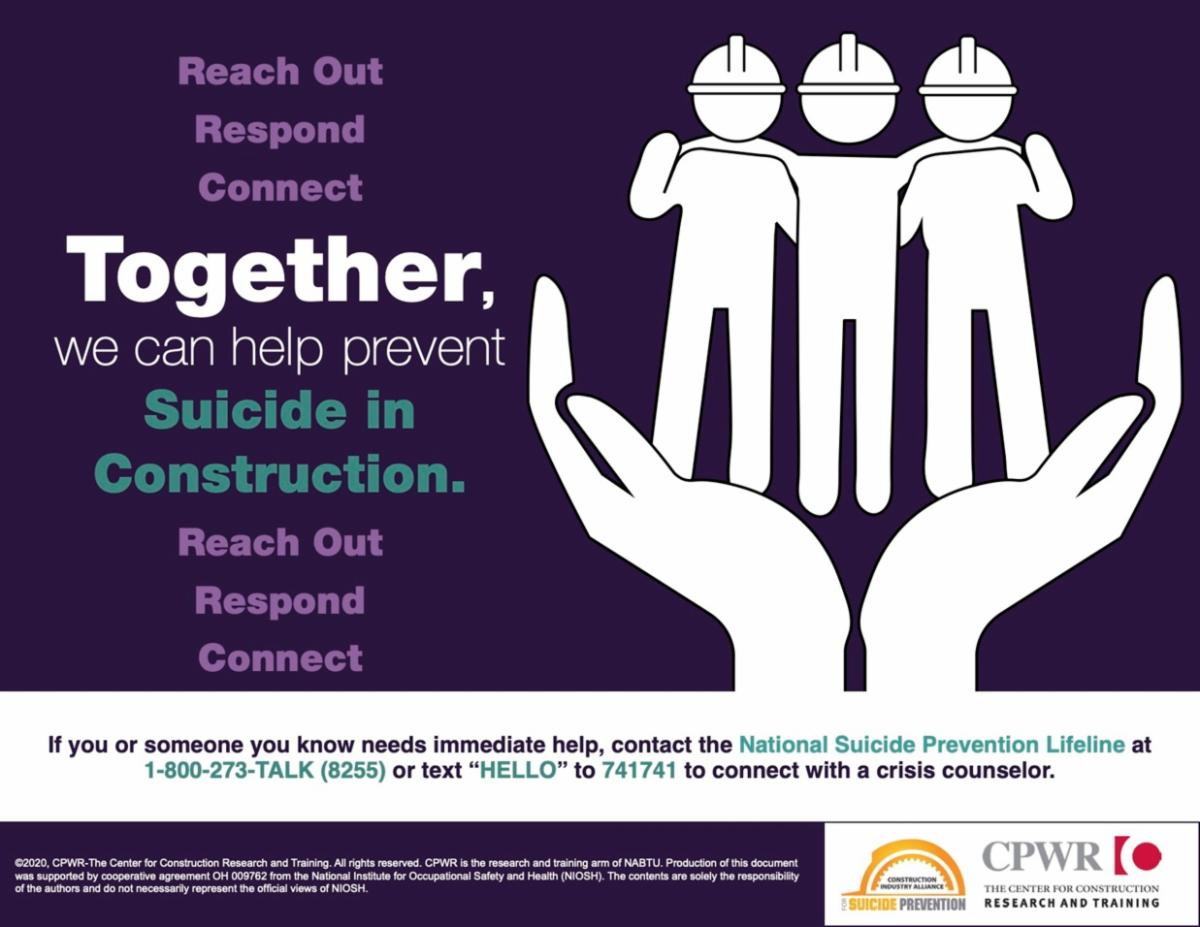
Construction workers continue to die from suicide at a rate four to five times higher than American workers overall. In addition, while just over 900 construction workers 16 to 64 years old died from jobsite incidents in 2024, more than 5,000 died from suicide. September is Suicide Prevention Awareness Month, creating an important opportunity for the construction industry to reflect and take action to prevent suicides.
Construction worker suicide is preventable. Science has proven that injuries, harassment, and lack of access to paid leave are associated with construction worker suicides. CPWR’s resources on preventing injuries and pain are available in several of our employer tools, and our just-published workplace violence prevention guide helps employers eliminate bullying and harassment. Our study on how employment laws and community-level factors influence suicide rates provides evidence on policies that can make a difference at the state level.
CPWR has many more free resources addressing suicide prevention. We monitor trends and share them widely through publications such as our Data Bulletins and the REASON newsletter, which earlier this year highlighted recent declines in suicides and especially overdoses. Our research explores topics such as the characteristics of construction workers dying from suicide and what makes an effective education and support program. We focus on bringing about change, from organizing workshops of people committed to this issue to supporting the development of evidence-based programs such as the new COMPASS program (Construction Organizations Mobilizing Peer Support & Suicide Safety). Also, register for this month's CPWR webinar, Preventing Suicide in Construction: Actions Anyone Can Take to Help.
Coming in the next two months are an updated version of COMPASS and a report on our latest workshop, which focused on expanding our prevention efforts.
| | TOOLS FOR SAFETY AND HEALTH | |
New Hazard Alert Cards on Battery Safety and PVC/CPVC Adhesives
CPWR’s collection of three dozen Hazard Alert Cards -- short, image-driven materials that deliver simple, direct messages for protection against safety and health hazards construction workers face -- has added two topics. Battery Safety responds to the industry’s growing use of batteries, from hand tools to heavy equipment to large-scale energy storage systems. PVC and CPVC Cement Products describes how to stay safe when using materials that chemically weld PVC/CPVC pipes and fittings together, fix leaks, and fill small gaps. Hazard Alerts are available in two formats, both free: printed cards folded to “pocket size” of 3 ½” x 5 ½” and one-page PDFs.
New Guide for Preventing Workplace Harassment and Violence
Last month CPWR released a guide to help construction employers develop and implement a program to prevent harassment and physical violence on jobsites. Acts of violence are the third leading cause of fatal occupational injuries in the U.S., and physical violence often follows harassment, intimidation, bullying, or other threatening behavior. Like other occupational safety hazards, workplace harassment and violence are recognizable, foreseeable, and preventable, and risks can be identified and mitigated with appropriate policies, procedures, and precautions. Developed through a review of relevant guidance and literature along with input from industry experts, “Preventing Workplace Harassment & Physical Violence in Construction” offers guidance on assessing risks, planning to prevent violence, and building a culture of care and respect, as well as a sample plan.
| |
Apply Now for a Small Study Grant
Since 1993, our Small Study Program has provided nearly 150 research teams with up to $30,000 to initiate short-term studies that:
- Investigate potential risks from emerging hazards and industry changes.
- Explore new approaches for addressing persistent hazards.
- Create and test promising interventions to improve worker health and safety.
- Accelerate research on emerging and persistent safety and health issues.
The program is particularly interested in projects that reach high-risk small employers and develop interventions that can be immediately applied on the job. Support for the Small Studies program comes through CPWR’s cooperative agreement with the National Institute for Occupational Safety and Health (NIOSH) and private sector funding from the McElhattan Foundation. Applications are reviewed on a rolling basis. Learn about the application process and past and current studies on the Small Studies main webpage.
| | |
Tuesday, September 15 at 6:00 p.m. ET
Preventing Suicide in Construction: Actions Anyone Can Take to Help
We’ve seen a small but significant decline in suicide deaths across the U.S. construction industry the last few years, but there are still FIVE TIMES as many workers dying from suicide than from traditional work-related hazards. To address many of the industry-related factors such as a lack of paid leave and high-pressure environment, action from leaders and decision makers is required. But we can all do something to help. Join CPWR-The Center for Construction Research and Training (CPWR), the Roofers & Waterproofers Research and Education Joint Trust Fund, and the Construction Industry Alliance for Suicide Prevention (CIASP) to learn more about:
- Advocating for and contributing to a caring culture
- Having the tough conversations
- Providing peer support
- Preventing workplace harassment and violence
Moderator: Chris Trahan Cain, CIH, Executive Director, CPWR
Panelists:
-
Keith Vitkovitch, Executive Director, Roofers & Waterproofers Research and Education Joint Trust Fund
-
Sonya Bohmann, Executive Director, CIASP
-
Jessica Bunting, MPH, r2p Program Director, CPWR & Vice Chair, CIASP Board of Trustees
Click to register and submit questions in advance.
Live Spanish interpretation will be available.
Tuesday, October 20 at 2:00 PM ET (1 1/2 hours)
Ask OSHA: Compliance with 29 CFR 1926.1153 - Respirable Crystalline Silica in Construction
Earlier this year, CPWR held a webinar on the re-launch of our Work Safely with Silica website and exposure control planning tool (www.silica-safe.org). We received numerous questions related to the implementation of and compliance with OSHA’s construction silica standard during that event. To answer those questions, CPWR has engaged OSHA for a follow-up webinar where attendees will hear directly from representatives of the Directorate of Technical Support and Emergency Management (DTSEM), the Directorate of Enforcement Programs (DEP), and the Directorate of Standards and Guidance (DSG). The panel will discuss topics such as the most common violations of the rule, medical examination requirements, and exposure control methods, based on questions from the previous webinar as well as those submitted during registration below.
Moderator: Chris Trahan Cain, CIH, Executive Director, CPWR
Panelists:
-
Jennifer M. Kim, MPH, CIH, Director, Office of Health Enforcement, DEP, U.S. Dept. of Labor, OSHA
-
Stephen Schayer, PhD, CIH, Director, Office of Physical Hazards, DSG, U.S. Dept. of Labor, OSHA
-
Minda Nieblas, MD, MPH, Director, Office of Occupational Medicine and Nursing, DTSEM, U.S. Dept. of Labor, OSHA
Click here to register and submit questions in advance.
Live Spanish interpretation will be available on a second channel during the event.
Wednesday, September 9, 2:00-3:30 p.m. ET
Former Worker Medical Screening Programs
The U.S. Department of Labor’s Energy Workers’ Compensation Program is partnering with the U.S. Department of Energy (DOE) to host a webinar discussing the DOE Former Worker Medical Screening Program. Moderators will discuss:
- Overview of the Department of Energy Former Worker Medical Screening Program
- Information on free medical screening programs, including Worker Health Protection Program (WHPP); National Supplemental Screening Program (NSSP); and the Building Trades National Medical Screening Program (BTMed), which is managed by CPWR
- Eligibility requirements for screening for current and former workers of DOE nuclear weapons facilities
- Available services for eligible workers
- How to enroll in free medical screenings
Discussion led by:
-
Greg Lewis, Director, DOE Office of Worker Screening and Compensation Support Office of Environment, Health, Safety and Security
-
Jonathan Corbin, Co-Director, WHPP
-
Miles Fisher, Program Director, BT Med
-
Jamie Stalker, Program Director, and Zac Hubbell, Program Coordinator, NSSP
-
Marek Mikulski, Director, and Jill Welch, Coordinator, University of Iowa FWP
Register for the webinar.
| | |
CPWR is currently looking for candidates for two positions:
CPWR is located in downtown Silver Spring, Maryland, close to public transportation and public parking. We offer competitive salaries and an exceptional benefits package. Learn more about the positions and working at CPWR from our website.
| | | | |