
These are the Small Studies in progress:
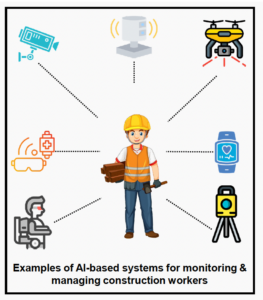
From the original proposal for the Virginia Tech study on AI adoption
Arizona State University, Enhancing Ladder Fall Monitoring and Prevention in Small Employers Using AI-Enabled Digital Twins (Richardo Eiris, PI). This study will develop a pilot “digital twin” ladder safety web-based app to prevent fall injuries for workers at small construction employers. The researchers hypothesize that ladder artificial intelligence (AI)-enabled digital twins can support any decision-makers (e.g., managers, supervisors, workers) in small construction companies to improve fall safety. This project has three aims: create an annotated ladder fall hazard dataset from real-world sites, develop a web app using AI-enabled digital twin for ladder fall hazard assessment and guidance, and evaluate the practicality of the digital twin web app through a user-centered experiment.
Lawrence Technological University, Emerging Safety Technologies for Smaller Construction Firms (Mamdouh Ali Ahmed Mohamed, PI). This study aims to determine the challenges and opportunities related to smaller construction firms’ adoption of emerging safety technologies. It will identify technologies, and related safety tasks, by systematically reviewing relevant literature, surveying smaller firms to identify best practices with these technologies, measuring their implementation maturity level of technology, and identifying challenges firms face when acquiring and employing safety technologies. Ultimately, the study will create guidelines to help smaller firms understand which emerging technologies they can use efficiently.
Oregon State University, Design impacts of prevention through design concept and resource implementation (John Gambatese, PI). This CPWR Small Study will develop greater understanding of the implementation of Prevention through Design (PtD) concepts and existing CPWR PtD resources during design, with the goals of evaluating their impact and supporting their expanded dissemination and use in the industry. The study will three main research objectives: (1) identifying the hazards commonly mitigated in the design of a facility and the associated changes made to the design; (2) documenting the conditions present and associated decision criteria when project teams choose to modify a design for greater safety and when they choose not to eliminate hazards through design; and (3) determining how to encourage PtD use in the U.S. and how existing CPWR resources could be improved to enable more effective PtD implementation. To fulfill these objectives, the researchers will analyze design review comments collected from projects being conducted by collaborating organizations and will observe and interview participants in design review meetings.
University of Illinois Chicago, Ladder injuries in the construction industry in Illinois (Brett Shannon, PI). This study will use Illinois workers’ compensation First Reports of Injury data over a six-year period to analyze severe non-fatal traumatic injuries caused by or during use of ladders on construction sites . This rigorous statistical analysis of ladder-related injuries will increase understand of the factors contributing to construction worker injuries and if these differ from the injuries to other workers in the state. Researchers will also stratify the data to evaluate differences in cause and severity of injury by construction company type (residential, commercial, specialty trade) and among vulnerable workers (low wage, minorities, youth, and self-employed).
University of New Mexico, Impact of OSHA-mandated versus self-selected rest breaks on heat strain and productivity: laboratory simulation study. (Fabiano Amorim, PI). The goal of this study is to determine how different rest-break strategies influence physiological strain and productivity during simulated construction work in a controlled hot environment. The hypothesis is that mandated rest breaks reduce physiological heat strain without causing proportional losses in productivity compared with self-paced work or no break.
University of Southern Mississippi, Temporary Wiring Hazards in Small Residential Construction: Assessing OSHA/NIOSH Guidance and Stakeholder Perspectives (Yuan Sun, PI). This study aims to evaluate the adoption and practical fit of OSHA/NIOSH temporary wiring recommendations in small residential construction and to identify feasible, low-cost strategies to improve worker safety. It will employ a mixed-method design integrating field observations, analysis of construction-related online forums, and semi-structured interviews with general contractors, subcontractors, and workers, especially electricians. In addition to identifying barriers and gaps, the study will explore ideas proposed by stakeholders to inform the development of practical and scalable interventions. Data will be analyzed using thematic coding and the Implementation Outcomes Framework to assess the acceptability, feasibility, and appropriateness of existing safety guidance.
Virginia Tech, Balancing AI Adoption for Construction Ethical & Professional Imperatives (Ashtarout Ammar, PI). This study’s overarching objective is to establish a worker-centered foundation for responsible AI adoption in construction that upholds beneficence and non-maleficence while supporting productivity and safety. The researchers will adopt a mixed methods and engage a broad set of industry stakeholders. The project’s specific aims are to: (1) identify and recruit subject-matter experts from four groups—practitioners using or planning AI, workers and their representatives, developers of AI applications, and researchers investigating AI adoption in construction; (2) identify, evaluate, and prioritize ethical implications and risks of AI-based worker monitoring and management systems across application types and stages of the AI lifecycle; and (3) translate consensus findings into actionable guidance for governance, training, and mitigation. Research methods will include a screening survey and transparent rubric to assemble a diverse, credible expert panel; a multi-round Delphi panel to rate and categorize risks, align them to representative applications, and locate where they originate and concentrate along the lifecycle; and targeted focus groups to validate and enrich results, co-creating feasible safeguards that do not compromise workers’ safety or well-being. Quantitative and qualitative analyses will produce a ranked risk register, a risk-by-application matrix, and a lifecycle mapping. This will inform a worker-centered governance checklist, an adoption decision aid, and a mitigation roadmap.
Texas State University, Improving Frontline Safety Decision-Making Through Micro-Interventions in Small Construction Firms (Fidelis Emuze, PI). This study will design and test a bilingual (English/Spanish) micro-intervention toolkit (low-cost behavioral prompts delivered at the point of safety-critical decision) with frontline supervisors in small residential and light commercial construction firms in Central Texas. A dedicated implementation science aim will identify facilitators and barriers to small contractors’ engagement with safety tools using the Consolidated Framework for Implementation Research (CFIR). The study plans to produce a validated, open-access bilingual toolkit.