
Employment Projections
The construction industry contains a rapidly growing and changing population of workers spread across a variety of trades, states, and demographics. Projections help to predict changes in industry composition, including which jobs are expected to grow while others shrink, creating better focus on areas in safety and health most needing attention.
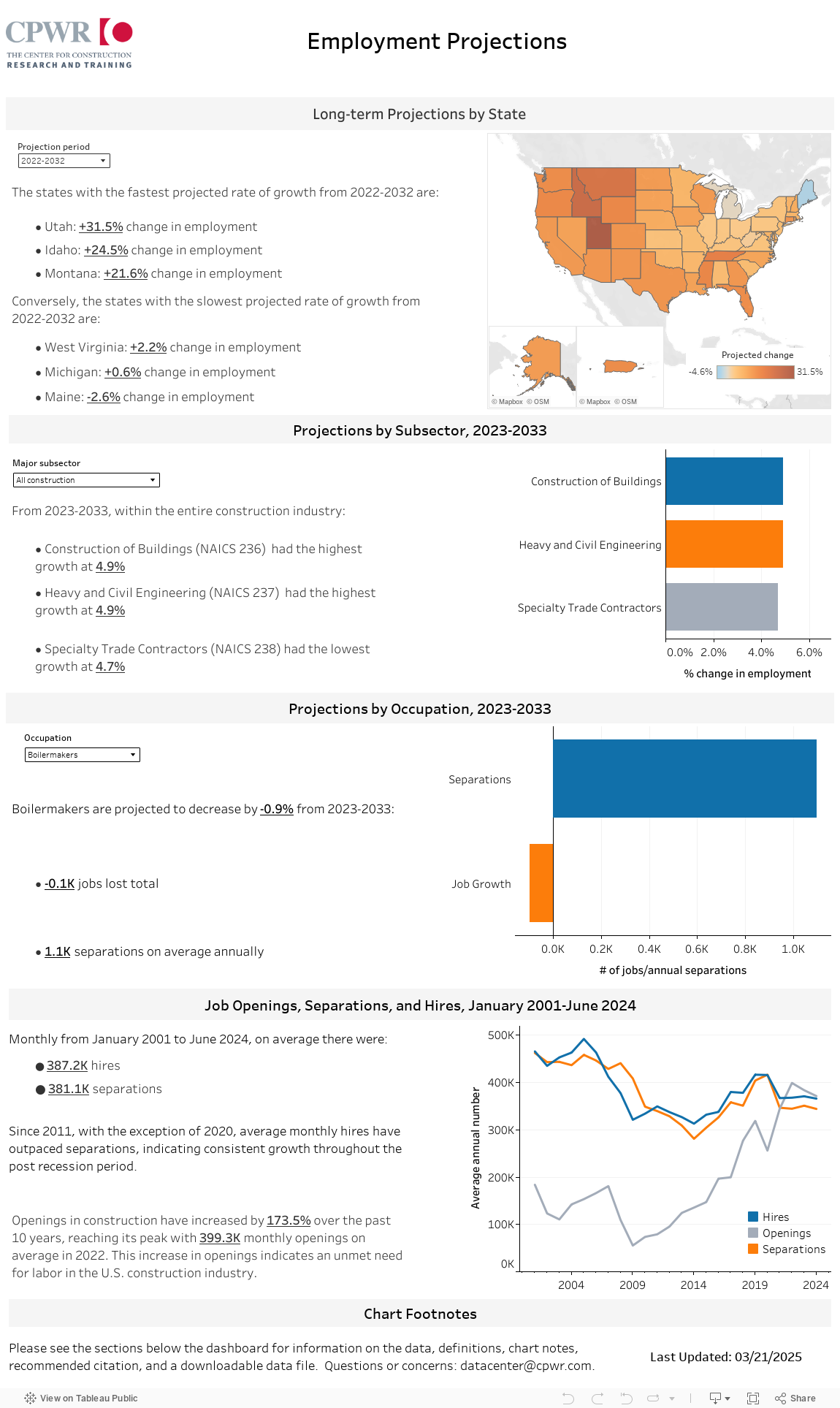
This interactive dashboard highlights data for construction worker projections by state, occupation, and construction subsector. There are no dashboard-level filters. There are two chart-level filters, the Major subsector and Occupation filters, which update both their respective charts and the bolded and underlined key findings.
Following the interactive dashboard, you will find more information on the data source, definitions, chart notes, a downloadable data file, and recommended citation. This interactive data dashboard corresponds to this chapter in the PDF version of the Construction Chart Book-7th edition. Data will be updated annually as available.
If you have any questions or comments, please email [email protected].
About the Data
U.S. Bureau of Labor Statistics. (2026). Occupational Employment Projections Data https://www.bls.gov/emp/data/occupational-data.htm.
U.S. Bureau of Labor Statistics (2026). Job Openings and Labor Turnover Survey (JOLTS). https://www.bls.gov/jlt/data.htm.
- Openings, new hires, and separations estimates are all seasonally adjusted.
Projections Central. (2026). State Employment Projections https://projectionscentral.org/home:
- Long-Term Projections 2024-2034 https://projectionscentral.org/longterm.
Definitions and Chart Notes
Definitions
- Detailed subsector – 4-to-5-digit NAICS codes within construction (under NAICS 23).
- Major subsector – 3-digit NAICS codes within construction (under NAICS 23).
- Openings – The sum of net occupational employment change and occupational separations. Workers who change jobs within an occupation do not generate openings since there is no net change in openings from this movement.
- Separations – the sum of labor force exits and occupational transfers.
- Labor force exits – workers who are leaving an occupation or exiting the labor force entirely.
- Occupational transfers – workers who transfer to a different occupation. These represent permanent separations, not temporary movements where a worker is expected to return to the same occupation in the future.
Chart Notes
Map: Data shown is for construction and extraction occupations and is not specific to the construction industry. Common construction trades are shown, but extraction workers may be included.